

About This Blog
This blog is two repos, not one. What you are reading lives in a small content repo: the posts, a theme, and a thirty-line Nix flakeNix flakeA self-contained Nix project with pinned inputs and a standard output schema, giving fully reproducible builds.. The machinery that turns that into a website lives in a separate project, niche.
I split it on purpose. The content should not know how it is built, and the build tool should not know what I write about. This page is the colophon for the content side. The niche post is the engine.
Instance and engine
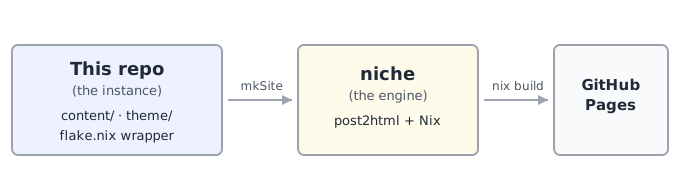
The instance is this repository. It holds:
content/— one directory per post: ameta.nix(title, date, tags, summary as a pure Nix attribute set) and apost.md. Some posts add anassets/dir or afigures.nix.theme/— TeraTeraA Rust templating engine with Jinja2-style syntax, used to render HTML pages from data.keats.github.io templates plus CSS and self-hosted fonts. Here that is a local copy of niche'sfancy-sidebartheme, with a MathJax include bolted on.flake.nix— the wrapper. It callsniche.lib.mkSite { contentDir = ./content; themeDir = ./theme; siteConfig = ...; }, then adds theCNAMEand.nojekyllthat GitHub Pages needs.
That is the whole instance. No generator code, no pipeline, no Rust. Pull the niche input, hand it three arguments, get a site.
The engine is niche: a Rust binary (post2html) wrapped by Nix, built as a compile/link/compose toolchain. If you want the architecture, the caching model, and the bugs it was born from, read the niche post.
Design principles
The visual design is typography-first: generous whitespace, a minimal palette, nothing competing with the text.
- Inter for body text, JetBrains Mono for code. Self-hosted as woff2WOFF2Web Open Font Format 2.0: a Brotli-compressed web-font format that shrinks font files for faster page loads., no CDNCDNContent Delivery Network: geographically distributed servers that cache and serve assets close to the reader..
- Dark mode with a small toggle, persisted in
localStorage, defaulting to your OS preference. - No CSS framework. CSS custom properties for theming. One
main.css, onecode.css. - Valid HTML5, semantic elements, OpenGraphOpenGraphA metadata protocol (og: meta tags) that controls how a link's title, image, and description render when shared.ogp.me tags, an Atom feedAtom feedAn XML syndication format that lets readers subscribe to a site's updates through a feed reader., canonical URLs.
- Minimal JavaScript: the dark-mode toggle, plus MathJax for math. The content itself is static HTML and CSS.
Because a theme is only read during the engine's compose phase, editing a template or a stylesheet never rebuilds a post. Only the final assembly reruns. That is why fiddling with CSS is cheap.
What AI built here
The content and the theme were designed and written by an AI (Claude, Opus), working interactively with a human (Mark). Every post, the theme templates, the CSS, the flake wrapper: all generated, all reviewed. Each change passed an architectural-review agent and a QA agent before it was committed.
The engine was built the same way, in its own repo, with its own PRDPRDProduct Requirements Document: a written spec of what a product must do, its goals, and its constraints., backlog, and review trail. The mistakes it made along the way (a source filter that broke incremental builds, a batched-compilation dead end) are worth reading: they are in the niche post.
Source
Two repositories tell the whole story:
- This instance — content, theme, and the flake wrapper: github.com/eisbaw/eisbaw.github.com.
- The niche engine — the Rust binary, the Nix library, the PRD, and the backlog: github.com/eisbaw/niche.
git log in either one is honest about how it got here. Start with the niche post if you want to know how the site is actually built.